
LaGuardia, March 22: When Every Layer of Defence Had a Hole
On the night of March 22, I was following live ATC feeds when Air Canada Express Flight 8646 dropped off the radar at LaGuardia. A CRJ-900LR, registration C-GNJZ, operated by Jazz Aviation, had struck a Port Authority ARFF fire truck while landing on Runway 4 at 11:45 PM. Both pilots — First Officer Antoine Forest, 30, and Captain MacKenzie Gunther, 38 — were killed. Forty-one others were hospitalised.
As a pilot, this one hits differently. Runway incursions are something you think about every time you taxi at a towered field. You trust the system — the controllers, the lights, the radar. What the NTSB preliminary findings reveal is that on this night, the system failed at every level. Not one thing went wrong. Everything went wrong.
No transponder on the truck
The Port Authority ARFF truck that crossed Runway 4 did not have a transponder. That is the most basic piece of equipment for surface tracking. Without it, the truck was invisible to the airport’s automated systems. You cannot track what does not broadcast. This is not a sophisticated failure — it is an equipment gap that should not exist on an active airfield in 2026.
ASDE-X saw nothing
LaGuardia has ASDE-X, the FAA’s surface detection system designed specifically to prevent runway incursions. It should have flagged the conflict. It didn’t. The FAA tech centre’s analysis, read aloud by NTSB Chair Jennifer Homendy, explained that ASDE-X did not generate an alert “due to the close proximity of vehicles merging and unmerging near the runway, resulting in the inability to create a track of high confidence.”
The system got confused by vehicles clustering near the runway and lost the track. The one piece of automation that existed to catch this — could not see it.
The lights were working
The runway status lights — the ones embedded in the pavement that turn red when a runway is active — were confirmed operational. They should have provided a clear, final warning to the truck crew. Whether the crew saw the lights and why they proceeded is still under investigation. But the lights did their job. Something between the lights and the decision to cross did not.
Conflicting clearances
Two minutes and seventeen seconds before impact, the tower cleared Flight 8646 to land on Runway 4. Twenty seconds before impact, the same tower cleared the fire truck to cross that runway. Both clearances were active at the same time. Nine seconds before impact, the tower issued a stop command to the truck. It was far too late.
If you have ever been on short final at approach speed, you know what twenty seconds means. You are committed. There is no go-around window when the conflict appears nine seconds out.
Two controllers, four positions
Two controllers were staffing the tower that night. Standard midnight shift configuration at LaGuardia — each controller working two positions. There is conflicting information about who was actually performing ground control duties. The NTSB is still sorting that out.
Homendy noted that controllers themselves have been raising this as a concern: “Our air traffic control team has stated this is a problem, that this is a concern for them for years.” She also pointed out that the systems they are working with have not kept pace: “Controllers should have all the info and tools they need to do their job. This is 2026.”
Two people doing four jobs, at midnight, during an active emergency. That is what the staffing picture looked like.
The emergency that started it all
The truck was not on the runway for a routine reposition. It had been dispatched to respond to United Airlines Flight 2384, a 737 MAX 8 bound for Chicago O’Hare. That aircraft had aborted its takeoff twice due to an anti-ice warning light. The crew then reported a foul smell in the cabin, flight attendants became ill, and an emergency was declared at 11:31 PM.
So the controllers were managing an active aircraft emergency, dispatching ARFF vehicles, and simultaneously running landing traffic on the same runway — with half the normal staffing. The very emergency that put the truck on Runway 4 was consuming the attention of the people who should have been protecting it.
Swiss cheese
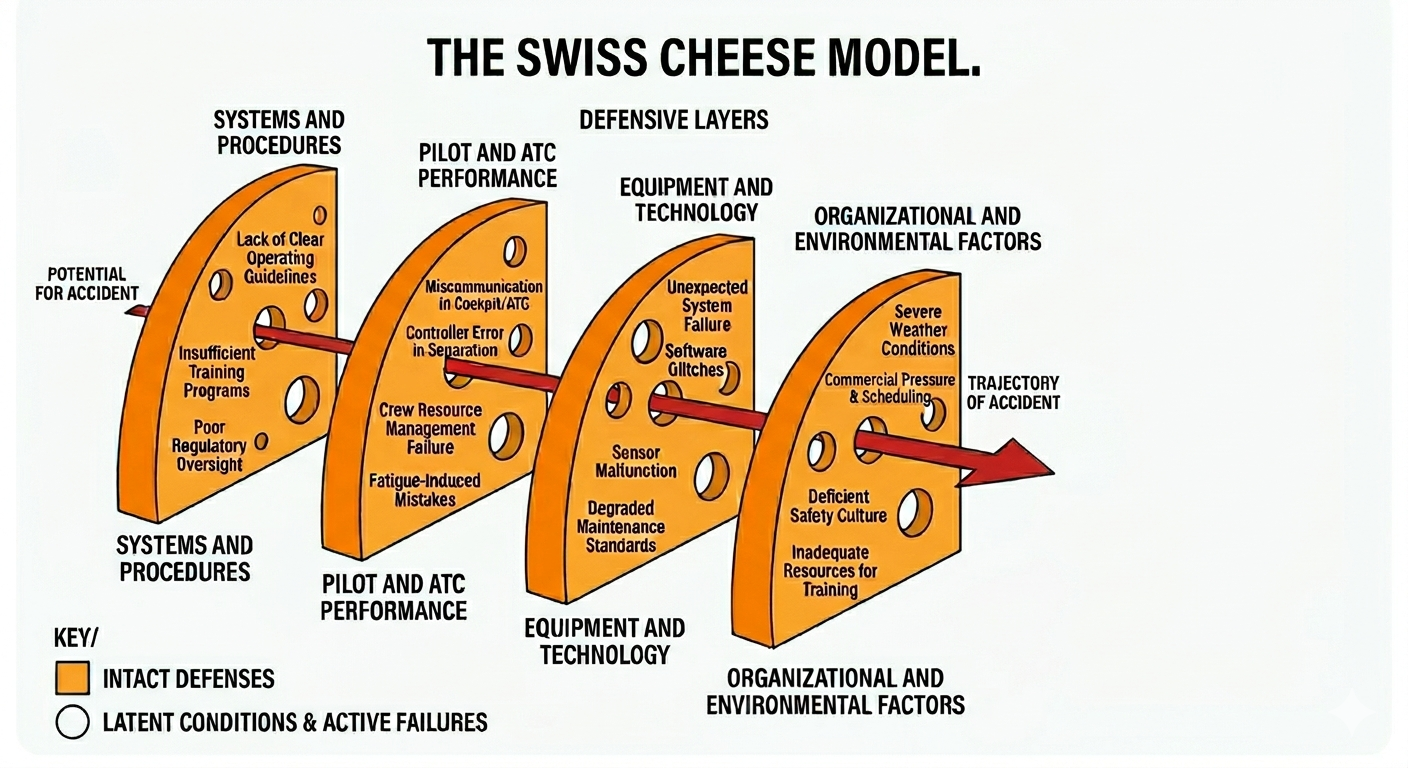
James Reason’s Swiss cheese model describes how accidents happen when the holes in multiple layers of defence line up. A transponder on the truck and ASDE-X builds a reliable track. A reliable track and the system generates an alert. An alert and the controller catches the conflict before issuing clearance. The truck crew heeds the runway status lights and holds short. A fully staffed tower and someone catches the error with enough time to act. No concurrent emergency and the truck is never there in the first place.
On this night, every layer had a hole, and they all aligned.
Homendy put it plainly: “We rarely, if ever, investigate an accident where it was one failure. Our aviation system is safe because there are multiple — multiple — layers of defense built in to prevent an accident. So when something went wrong, that means many, many things went wrong.”
The investigation is ongoing. But the preliminary picture is already clear — this was not a single mistake. It was an entire system of defences failing together, with twenty seconds of margin between routine operations and a fatal accident.